
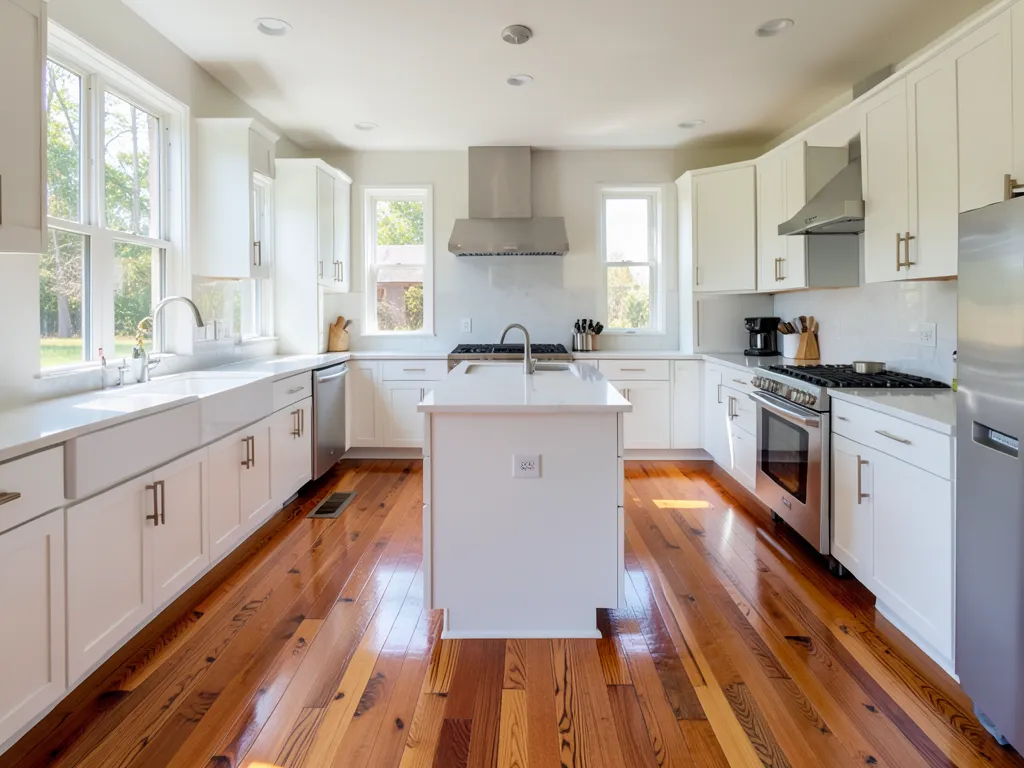
Kitchen Hardwood Refinishing Guide Greenville SC
Your kitchen floor works harder than any other surface in your Greenville home. Between morning coffee spills, pet bowls, dropped pans, and the constant shuffle of foot traffic from the hallway to the back door, kitchen hardwood takes a beating that living rooms and bedrooms never see. At Pioneer Concepts LLC, we've spent more than 15 years restoring kitchen floors across Greenville, Spartanburg, Anderson, and Pickens — and we've learned that a little targeted care goes a long way. This guide walks you through how to tell when your kitchen floor needs refinishing, what the process looks like, and how to protect your investment from Upstate South Carolina's humidity swings.
Why Kitchen Hardwood Degrades Faster Than the Rest of Your Home
Wood floors in a kitchen face a unique combination of threats that accelerate wear:
- Moisture exposure — sinks, dishwashers, ice makers, and refrigerator lines all leak eventually. Even small, slow drips can stain and warp oak planks over time.
- Grease and cooking oils — airborne grease settles into the finish and dulls it, while spills near the range can soften and break down the protective layer.
- Constant foot traffic — the path from the sink to the island to the refrigerator gets walked dozens of times a day, wearing finish along predictable lanes.
- Chair and appliance drag — barstools, high chairs, and the occasional scooted dishwasher create scratches that cut through the topcoat.
- Upstate humidity swings — Greenville summers push indoor humidity high, then winter heating dries the air out. That cycle expands and contracts wood, causing gaps and, in severe cases, cupping.
Homes near the Reedy River and along the Swamp Rabbit Trail corridor tend to sit in pockets of higher ambient moisture, which makes kitchen floor maintenance even more important. If your kitchen is over a crawlspace, that risk multiplies.
Signs Your Greenville Kitchen Floor Is Ready for Refinishing
Dulling, traffic lanes, and surface scratches
Run your hand across the floor in front of the sink and again near the pantry. If the finish feels rougher in one area, or if you can see lighter, faded paths where the sheen has worn away, the topcoat is thinning. This is the earliest stage of wear — and the best time to act, because a professional hardwood floor refinishing service can often restore the floor without replacing a single board.
Dark stains, water rings, and gray patches
Black or dark gray staining around the dishwasher, sink base, or refrigerator usually means moisture has penetrated past the finish into the wood itself. Light surface stains can sometimes be sanded out during a standard refinish. Deep staining that goes all the way through the plank may require board replacement before sanding begins.
Cupping, crowning, and visible gaps
If individual boards look like little cups — edges higher than the center — or if your floor feels like a washboard when you walk across it barefoot, moisture is the likely culprit. Gaps between planks that open up every winter and close every summer are normal to a degree, but gaps that stay open year-round or exceed the width of a dime suggest the flooring has moved permanently.
If you see buckling near a leak, don't wait. Our team handles emergency water damage repair for hardwood floors across the Upstate, and fast action is the difference between a sand-and-refinish project and a full floor replacement.
The Kitchen Refinishing Process: What Greenville Homeowners Can Expect
Step 1 — Free in-home estimate and assessment
We walk your kitchen, measure square footage, check for moisture problems, test for finish thickness, and talk through your goals. You get a clear, upfront written estimate with no hidden costs. If a simple buff-and-coat will solve your problem, we'll tell you — even though it's the cheaper option.
Step 2 — 99% dust-free sanding
This is where Pioneer Concepts LLC separates itself from crews still using older equipment. Our HEPA-certified dust containment system captures 99% of sanding dust at the source. That matters enormously in a kitchen, where open shelving, exposed pantry items, and cabinets without doors collect particles in seconds.
Instead of sealing off your kitchen with plastic and cleaning for days afterward, you get a controlled, contained process. Families in neighborhoods like Augusta Road, North Main, and Alta Vista frequently tell us the dust-free approach is the reason they finally scheduled the project they'd been putting off for years.
Step 3 — Repairs and board replacement
Before finishing, we address squeaks, loose boards, damaged planks, and any transitions where the kitchen meets tile, LVP, or a hallway. Matching new boards to 40-year-old oak takes an experienced eye, and it's one of the things our 15+ years of local experience is worth.
Step 4 — UV-cured finishing
We apply finish and cure it instantly with UV light. Traditional oil-based and water-based polyurethanes need 24 to 72 hours before you can walk on them and several days before you can move appliances back. UV-cured finishing changes that equation entirely — you're back in your kitchen the same day.
Step 5 — Final walkthrough
We review the finished floor with you, explain the cure schedule, and hand over simple care instructions tailored to your finish and the humidity levels in your home.
Why UV-Cured Finishing Is Ideal for Greenville Kitchens
UV-cured finishes offer benefits that match Upstate South Carolina's climate and lifestyle almost perfectly:
- Instant dry time — no hotel stays, no eating out for a week, no rescheduling your family's routine.
- Superior durability — the cured finish resists scratching and scuffing better than conventional polyurethane, which matters in a room with constant chair movement.
- Eco-friendly formulation — low VOC content means fewer odors and better indoor air quality for your household, including pets and kids.
- Humidity resistance — a harder, more tightly bonded finish is less vulnerable to the moisture swings that plague Upstate homes in July and January alike.
- Consistent sheen — the UV curing process produces an even, factory-like appearance without the lap marks or uneven spots that can show up with hand-applied finishes.
Buff-and-Coat vs. Full Refinishing for Kitchen Floors
Not every dull kitchen floor needs a full sand-down. If the damage is limited to surface scuffs, light scratches, and a worn sheen — and the wood underneath is still sound — a buff-and-coat service may be all you need. It's faster, less expensive, and produces a beautiful result.
Full sanding and refinishing is the right call when you have deep scratches, staining, cupping, gaps, or a finish that's been applied many times over the years. During your free estimate, we'll tell you honestly which category your floor falls into.
Choosing Stain and Sheen for a Greenville Kitchen
Kitchen design trends in the Greenville area have shifted toward two directions: warm, natural oak tones that highlight the character of older homes, and cool, modern gray-brown blends for renovated open-concept kitchens in Simpsonville, Greer, and Mauldin.
On sheen, most kitchen clients choose satin or matte. Gloss looks striking in photos but shows every smudge, water spot, and crumb in real life — especially under the bright task lighting common in modern kitchens. Satin hides everyday imperfections and still gives you easy cleanability.
Seasonal Kitchen Floor Care for Upstate South Carolina
Spring
Pollen season arrives alongside rising humidity. Keep entry mats at the doors closest to the kitchen, sweep or vacuum frequently, and watch crawlspace humidity levels. If you're planning a refinish, spring and early summer are ideal — you can ventilate the house without fighting the cold.
Summer
Afternoon thunderstorms are a Greenville staple. Check under the sink and around the dishwasher after heavy rain, and never ignore a swollen toe kick or a slight ripple in the floor near the exterior wall. That's often the first visible sign of a water intrusion problem.
Fall
Relief from humidity brings those seasonal gaps back. Small, even gaps are normal and will close again. Clean them gently — never fill them with wax or caulk, which traps moisture and creates bigger problems.
Winter
Heating drops indoor humidity, often below 30%. A whole-home humidifier or a simple room humidifier in the main living areas helps your floors stay stable and prevents finish from drying out and cracking.
When Refinishing Isn't the Answer: LVP for Kitchens
Sometimes hardwood in a kitchen just doesn't make practical sense — for example, in a basement kitchenette, a rental property, or a home where water exposure is unavoidable. In those cases, luxury vinyl plank is a smart alternative. It's waterproof, affordable, and today's LVP looks remarkably like real wood. We install high-quality LVP throughout Greenville and surrounding areas, and we're happy to compare options with you side by side.
Kitchen Floor Refinishing in Greenville and Nearby Communities
Pioneer Concepts LLC serves homeowners throughout the Upstate, including Greenville, Spartanburg, Anderson, Pickens, Simpsonville, Greer, Mauldin, Taylors, Easley, Duncan, Fountain Inn, Berea, Pelzer, Lyman, Wellford, Clemson, and Aiken. Whether you're in a century-old bungalow near Falls Park, a family home off Pelham Road, or a newer build in Verdae, we tailor the approach to your floor's species, age, and condition.
Ready to bring your kitchen floor back to life? Call (864) 477-1424 or request your free estimate online. Same-day UV-cured finishes, 99% dust-free sanding, transparent pricing, and a family-owned team that treats your home like our own — that's the Pioneer Concepts LLC difference.